

small-to-medium breed
Lagotto Romagnolo
The one breed developed specifically to find truffles, and the job shows in everything about them - a nose that wants a problem to solve, a handler focus that makes training genuinely easy, and a woolly coat that felts instead of shedding. Lagotti are warm with children and other animals and live an unusually long time. Two inherited conditions, juvenile epilepsy and a lysosomal storage disease, are the ones to ask a breeder about.

Pup Height
16-19 in

Pup Weight
24-35 lb
Males 17-19 in and 28.5-35 lb, females 16-18 in and 24-31 lb. A dense woolly curled coat over the whole body including the head, with pronounced eyebrows, beard and whiskers - it is waterproof and does not shed, which is why the breed is often described as hypoallergenic. Off-white, white with brown or orange patches, brown roan, or solid brown, sometimes with a brown mask. Source: AKC breed standard.

Pup Lifespan
15-17 years
Your pup, at a glance
What’s Life With This Pup Really Like?

Very high. They are affectionate and physically close with their family and want to be in whatever room the people are.

Excellent. Cheerful, patient and sturdy, with no sharpness and a genuine enthusiasm for being included.

Very good. Sociable with dogs and generally fine with cats, with a modest prey drive aimed mostly at things underground.

Moderate. They announce arrivals readily and train down easily, and an under-worked Lagotto barks more.

Moderate to high. Ninety minutes with real scent work, and they settle genuinely well indoors afterward.

The lowest on this site alongside the Kerry Blue. The coat felts rather than sheds, which is why it needs combing and clipping.

Enthusiastic and inventive, with a strong preference for games that involve finding something.

Very low, though a wet beard drips across the floor.

Outstanding - among the highest here. Quick, willing and unusually good at scent tasks.

Strong as an alarm. Alert and quick to announce, with no guarding instinct behind it.

High. Combing every week or two plus a professional clip every couple of months, for life.

Good. Apartments and houses suit them equally, provided the nose gets a job and the coat is kept up.
Lifestyle fit
Could This Be Your Best Breed?
A Lagotto Romagnolo fits an apartment as easily as a house, provided the hour or ninety minutes a day includes scent work rather than pavement. Fifteen to seventeen years at $1,400 to $2,300 a year is a long, affordable run for a dog this capable. Anyone who wants a low-shedding dog to simply potter along beside them should choose a quieter-minded breed - this one finds a job of their own, usually in the lawn.

Living Space
Apartment or house, either works. They are medium-sized, adaptable and low-shedding - what they need is a job for their nose rather than square footage, and they dig if the job does not arrive.

Pup Experience
Good for a first-time owner who will actually use the nose. They are one of the most trainable breeds there is; the failure mode is boredom rather than difficulty, and a bored Lagotto excavates.

Daily Pup Time
An hour to ninety minutes daily with real scent work in it. Grooming is a comb-through every week or two plus a clip every couple of months.

Allergies & Coat
The Lagotto Romagnolo scores 1/10 for shedding and 2/10 for drooling. No dog is truly hypoallergenic. The allergens come from dander and saliva, and a coat like this one holds on to them rather than spreading them around your home - which is what a groomer is clearing out every six to eight weeks.
Quirks & challenges
The Not-So-Easy Stuff

They Dig
Truffle hunting is digging. Give them a sanctioned spot and scent games, or lose the flower beds.
The Coat Mats
Dense wool that does not shed, so it felts. Combing every week or two and clipping every couple of months.
They Need Nose Work
Physical exercise alone bores them. Scent games, tracking or nose work is the actual requirement.
Alarm Barking
Alert and quick to announce. Trains down easily and is worth doing early.
Storm and Noise Sensitivity
Documented in the breed. Worth building confidence early rather than discovering it in a thunderstorm.
Juvenile Epilepsy
A breed-specific form with a DNA test. Ask for both parents' results rather than a reassurance.
The good, the bad & the hairy
Health, Care & Costs
Understanding the health risks and ongoing costs of a Lagotto Romagnolo helps you plan for a happy, healthy life together.

15-17 years
$65-$100
per groom (clip, bath, beard, ears, feet, nails), every 8-10 weeks ($400-$700/year)
$1,400-$2,300/year
all-in (food, routine vet, grooming, insurance, incidentals)

Health Risks
Conditions this breed is prone to.

A breed-specific form in which puppies have seizures from about five to nine weeks old. Unusually, most affected dogs grow out of it by four months with no lasting effects - but it is distressing and it is inherited. There is a DNA test, so a breeder who tests both parents removes it entirely.
A rare inherited neurological disease specific to the breed, causing progressive loss of coordination and behavioral change in young adults. It is fatal, it is DNA testable, and testing both parents removes the risk - ask for the certificates.
The joints develop loosely or unevenly and wear into arthritis, sometimes needing surgery. Present at moderate rates and screened by scoring both parents.
Drop ears covered in dense curls trap warmth and moisture against the canal, and a dog who works wet ground makes it worse. Weekly checking, cleaning and drying is the whole prevention.
The retina degenerates gradually until the dog is blind, usually starting with night vision. There is no treatment and a DNA test exists, so tested parents remove the risk.
The adrenal glands underproduce, causing vague symptoms - lethargy, vomiting, weakness - that can suddenly become a life-threatening crisis. It appears in the breed, is diagnosed by blood test, and is managed with lifelong medication.

Insurance & Health Coverage
A healthy breed with an unusually long life - fifteen to seventeen years is among the best on this site - so you may be paying premiums for a long time. Insure young and check how the policy prices renewals into old age.

Three of the breed's serious conditions are congenital and therefore uncovered by any policy: juvenile epilepsy, the storage disease, and progressive retinal atrophy. All three are DNA testable, which makes the breeder's test panel the real protection rather than the insurance. Ask for it in writing.

What insurance does cover is Addison's disease, which is managed with lifelong medication and monitoring - check how ongoing conditions are handled across renewal years rather than just the first claim. Grooming is the recurring cost outside any policy.
 Get a Pet Insurance Quote
Care needs
The Daily Routine

Grooming
A dense woolly coat that felts rather than sheds, so it needs combing right through every week or two - the surface looks fine while mats form underneath - and a clip every eight to ten weeks. The coat is deliberately kept in a natural, slightly shaggy shape rather than sculpted. Wipe the beard after meals and water, and check the ears weekly, especially after swimming.

Exercise
An hour to ninety minutes daily, and the scent half matters more than the distance. Nose work, tracking, truffle or mushroom hunting and swimming all suit them far better than a walk on pavement.

Food & Weight
Two measured meals. They are food-motivated and the coat hides weight gain, so go by feel through the ribs and count the training treats.
Similar breeds
If This Isn’t Quite the One

Barbet
The closest relative - a French water dog with the same woolly non-shedding coat and comparable temperament. The Barbet is larger and more of a retriever; the Lagotto is smaller, more nose-driven and considerably easier to house.
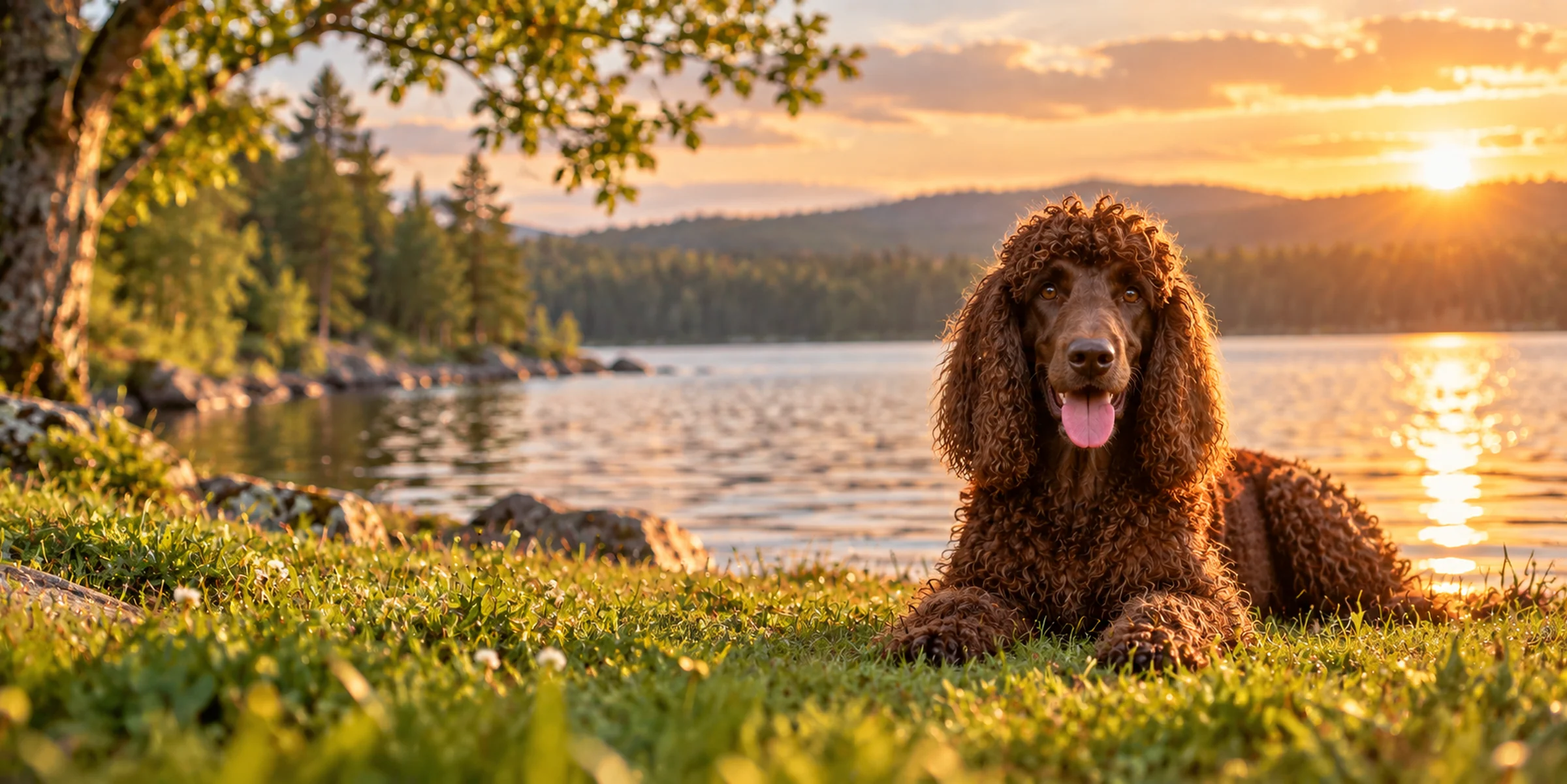
Irish Water Spaniel
Another curly-coated water dog with similar grooming and a similar sense of humor. The Irish Water Spaniel is much larger and needs twice the exercise; the Lagotto is the more manageable companion.