
Goldendoodle vs Labradoodle: Which Doodle Is Right for You?
Two Poodle crosses, nearly identical on paper. The differences that matter are energy, temperament and how much coat work you sign up for.
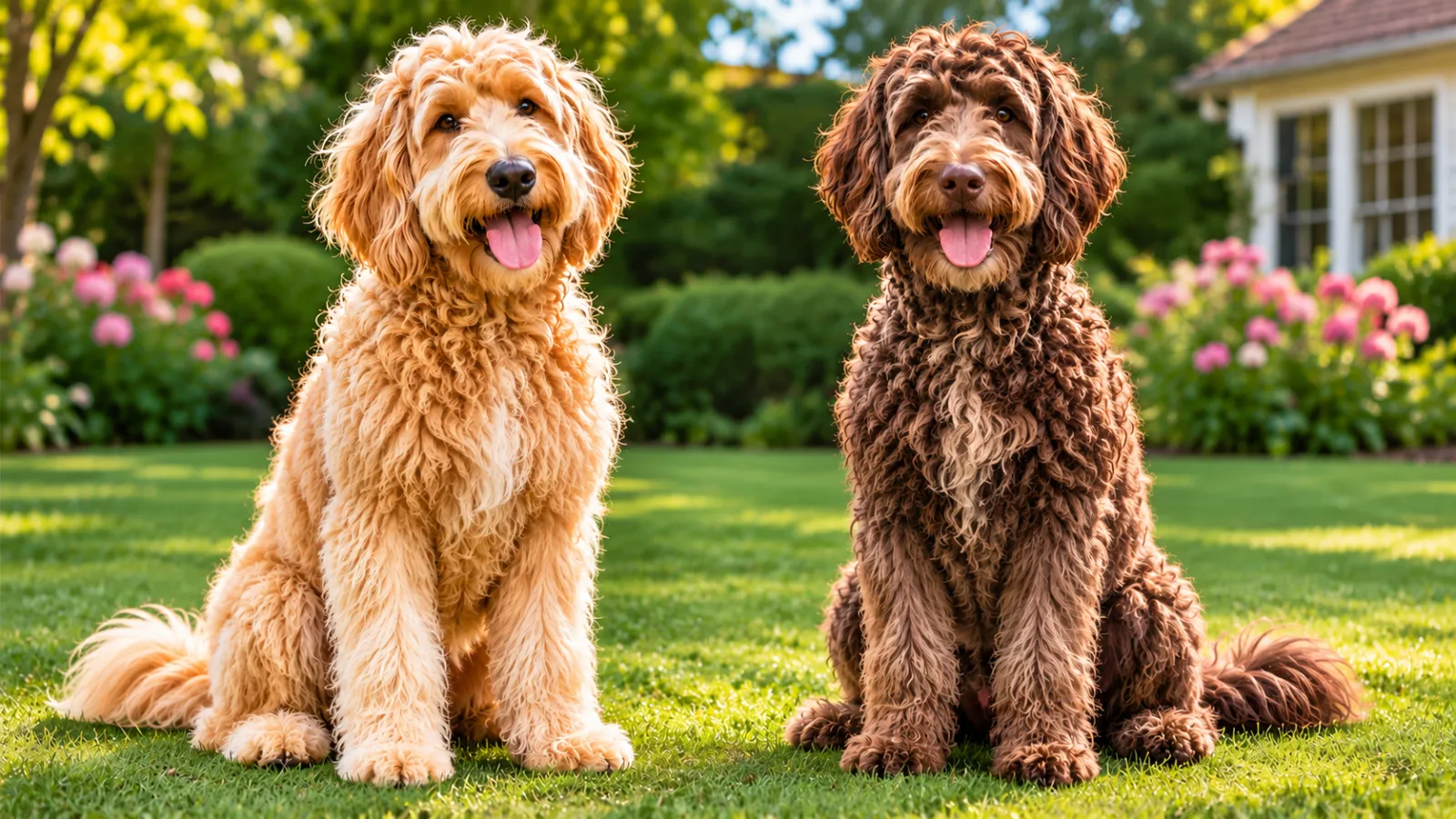
On paper they are almost the same dog. Both are a retriever crossed with a Poodle, both are sold on a friendly nature and a low-shedding coat, and both come in mini, medium and standard sizes. Plenty of people use the names interchangeably.
But the retriever half is not the same retriever, and it shows. The real differences come down to energy, temperament and how much coat work you are signing up for - so here is the honest side-by-side.
At a glance
| Goldendoodle | Labradoodle | |
|---|---|---|
| Weight | 15-90 lb | 18-75 lb |
| Height | 13-26 in | 14-24 in |
| Energy | 7/10 | 8/10 |
| Shedding | 3/10 | 3/10 |
| Grooming need | 9/10 | 8/10 |
| Trainability | 9/10 | 9/10 |
| Good with kids | 9/10 | 9/10 |
| Grooming, per year | $520-$1,100 | $450-$900 |
| Total, per year | $2,200-$3,600 | $2,000-$3,400 |
| Lifespan | 12 years | 12 years |
The short answer
The Goldendoodle is usually the softer, slightly calmer dog. The Labradoodle is usually the more energetic one, with more of the Labrador’s appetite and bounce. Both are affectionate, very trainable and great with kids. Neither is guaranteed to be low shedding, and neither is hypoallergenic.
Energy and exercise
This is the biggest day-to-day difference. A Goldendoodle needs around 45 to 75 minutes a day - less driven than a Labradoodle, but still a sporting cross, so a walk around the block is not enough. A Labradoodle needs 60 to 90 minutes, ideally split into two sessions with at least one proper off-leash run. Both swim readily, which is an easy way to burn energy without loading the joints.
That gap matters most in small homes. A mini Goldendoodle is genuinely apartment-friendly. A Labradoodle can live in an apartment only if you are truly committed to two walks a day plus real running several times a week.
Temperament
Both are people dogs first. They are affectionate, sociable with other dogs and quick to learn, and neither makes much of a watchdog - they will bark at the door and then want to be friends.
The Goldendoodle tends to have the softer edge. The Labradoodle brings the Labrador’s food drive and the Poodle’s problem-solving, which makes them fast learners in both directions: they pick up bad habits exactly as quickly as good ones. Expect counter surfing, a mouthy puppy stage and a lead-pulling phase somewhere between six and eighteen months.
The thing they share most is the one that catches owners out. Both bond hard and cope badly with being left. Separation anxiety is the most reported problem in the Goldendoodle, and long working days are the common failure case for the Labradoodle.
Coat and grooming
The low-shedding coat is why most people choose a doodle, and it is never guaranteed. These are crosses with no breed standard behind them, so coat type varies from litter to litter and even between littermates. The puppy you take home may need more upkeep than the one you met.
Either way, you are trading vacuuming for grooming. Wool and fleece coats on a Goldendoodle need brushing to the skin every day; a Labradoodle needs it three or four times a week. Both need a professional groom every six to eight weeks for life, and both coats mat fast - miss a few brushes and the coat has to be shaved off rather than brushed out.
Worth knowing: the most valuable thing to train into a doodle puppy is not sit or recall but tolerance of handling. A stranger will be clipping their face, feet and tail every six weeks for the rest of their life, and dogs that learn to accept it young stay easy to groom.
And if allergies are the reason you are looking, a low-shedding coat is not the same as hypoallergenic - no dog is. Our allergy-friendly breeds page explains why, and which breeds give you the best odds.
Size
Neither cross has a breed standard, so size depends on which Poodle was used. Goldendoodles run from about 15 pounds for a mini to 90 for a standard; Labradoodles from about 18 to 75. The two parents’ actual weights are the only useful guide to what your puppy will grow into - ask for them.
Health
The two share most of their risks: hip and elbow dysplasia, an inherited eye disease called progressive retinal atrophy, ear infections from hairy, floppy ears, bloat in the larger sizes, and skin allergies.
Each also carries something from its own retriever side. Goldendoodles can inherit the Golden Retriever’s higher cancer risk, plus a clotting disorder from the Poodle line. Labradoodles can inherit exercise-induced collapse from the Labrador line, where hard exercise makes the back legs give way; there is a DNA test for it.
Because health testing is inconsistent across doodle breeders, the parents’ hip and elbow scores and DNA results are the most useful thing a breeder can show you.
Cost
They cost about the same to keep: roughly $2,200 to $3,600 a year all in for a Goldendoodle and $2,000 to $3,400 for a Labradoodle. The line most first-time doodle owners do not budget for is grooming - $80 to $130 a visit for a Goldendoodle and $70 to $110 for a Labradoodle, every six to eight weeks.
Which doodle is right for you?
A Goldendoodle if you want a Golden’s gentle nature with less hair, someone is home most of the day, you can manage 45 to 75 minutes of exercise, and you have budgeted honestly for the groomer.
 GoldendoodleRead the full Goldendoodle profile
A Labradoodle if you are an active family with a yard, you have 60 to 90 minutes a day for the dog, and you are ready to keep a clever, food-driven dog busy.
 LabradoodleRead the full Labradoodle profile
Neither, probably, if the house is empty all day, the budget is tight, or you need a dog that is guaranteed not to set off an allergy. Choosing a doodle for the coat alone is how too many of them end up in rescue.
Still deciding? Read the full profiles above, or search any breed to see the good, the goofy and the hard parts before you fall for the puppy.