

medium breed
Blue Picardy Spaniel
One of the gentlest working breeds there is - calm, quiet, affectionate, superb with children and other dogs, and noticeably softer than most gundogs to train. Blue Picardy Spaniels settle well indoors, are not territorial and make easy neighbors. What they do need is a real hour of exercise every day and company for most of it, because a dog bred to stay near a walking handler does badly left on their own.

Pup Height
22-24 in
The standard gives one height range for both sexes, with females at the lower end. The blue is an effect rather than a pigment - dense black and gray speckling over white, broken by black patches, which reads as slate at a distance. The Blue Picardy Spaniel is a separate breed from the Picardy Spaniel it came from, not a color variety of it. Source: FCI breed standard.

Pup Weight
43-45 lb

Pup Lifespan
12-13 years
Your pup, at a glance
What’s Life With This Pup Really Like?

Very affectionate and closely bonded. They were bred to work at their handler's side and behave the same way indoors - in the room, near you, leaning if allowed.

Excellent - among the best here. Gentle, patient, playful and entirely without edge, and a sensible size for a family rather than an overwhelming one.

Very good. Sociable with other dogs and generally fine with cats. There is real bird drive from the gundog history, so poultry is a different question.

Low. They are not territorial dogs and do not announce much, which makes them easy neighbors for a breed with this much energy.

High. An hour to ninety minutes daily, and they genuinely settle afterward rather than pacing the way the herding breeds do.

Moderate. A medium coat with feathering that sheds steadily rather than seasonally, and comes out on the comb more than on the furniture.

Enthusiastic and water-mad. Retrieving games hold them indefinitely, and Blue Picardy Spaniels stay playful well into middle age.

Very low. A clean, dry-mouthed dog.

Very good. Bright, willing and handler-focused by breeding, and soft enough that reward-based work is not just preferable but necessary.

Poor. They will notice a visitor and go to meet them. The friendliness is the point of them.

Moderate. Twice-weekly brushing, a comb through the feathering after country walks, weekly ears, and very little trimming.

Good on environment, poor on absence. They settle into new homes and routines readily; what they do not adapt to is being left alone all day.
Lifestyle fit
Could This Be Your Best Breed?
A Blue Picardy Spaniel suits a house with a yard and a family that actually walks - including a first-time owner, which is unusual for a gundog. Costs are low by working-breed standards at $1,500 to $2,400 a year over twelve or thirteen years. Anyone out of the house all day, anyone who corrects a soft dog, and anyone unwilling to hunt down a rare French breeder should look elsewhere.

Living Space
A house with a yard and a household that walks. They are quiet, settle well indoors and are not territorial, which makes them an easy neighbor - the constraint is the exercise rather than the space.

Pup Experience
Good for a first-time owner with the time. They are soft, biddable and genuinely easy to train, and the two things that need attention are an hour of real exercise a day and a sensitivity that makes harsh handling counterproductive.

Daily Pup Time
An hour to ninety minutes of exercise with something for the head in it, plus brushing twice a week, weekly ears, and a check through the feathering after any walk in long grass.

Allergies & Coat
The Blue Picardy Spaniel scores 4/10 for shedding and 2/10 for drooling. No dog is truly hypoallergenic. The allergens come from dander and saliva, and a dog that sheds this much will leave plenty of hair behind - especially on your furniture, floors, and clothes.
Quirks & challenges
The Not-So-Easy Stuff

They Need a Real Hour
A working gundog's stamina in a family dog. Under-exercised they become restless and mouthy rather than destructive, but they do not settle.
Sensitive to Correction
Soft-natured to a degree that surprises people. Telling them off shuts them down; reward-based work gets a great deal out of them.
Hates Being Left Alone
Bred to work at their handler's side and closely attached because of it. Long solo days are the worst fit for this breed.
Ears Need Weekly Care
Long feathered drop ears on a dog who goes into water. Weekly cleaning and drying prevents infections that otherwise recur.
Feathering Picks Up Burrs
The leg and ear feathering collects seeds, burrs and mud. A comb-through after country walks, not just on grooming day.
Hard to Find Outside France
Genuinely rare, with few breeders anywhere else. Expect a wait, and a small gene pool worth asking about directly.
The good, the bad & the hairy
Health, Care & Costs
Understanding the health risks and ongoing costs of a Blue Picardy Spaniel helps you plan for a happy, healthy life together.

12-13 years
$55-$85
per groom (bath, tidy, feathering and ears), every 8-10 weeks ($300-$550/year)
$1,500-$2,400/year
all-in (food, routine vet, grooming, insurance, incidentals)

Health Risks
Conditions this breed is prone to.

The hip joint develops loosely, so the ball and socket grind instead of gliding. It leads to arthritis and, in severe cases, replacement surgery. A small breeding population makes parental hip scores a requirement rather than a nicety - ask to see them.
Long feathered drop ears on a dog who works wet ground and swims willingly. Structural rather than inherited, and the most predictable recurring cost in the breed - weekly cleaning and thorough drying is genuine prevention.
An inherited disease that slowly destroys the retina. Night vision goes first, then daylight vision, usually ending in blindness. There is no treatment, but it is painless and gradual, and eye clearances on both parents are the protection.
Similar to hip dysplasia but in the elbow joint - the bones do not fit together properly, causing pain and early arthritis. Treatment ranges from management to surgery depending on severity.
The thyroid stops producing enough hormone, causing weight gain, lethargy and a coat that thins or dulls. A daily tablet manages it completely and the medication itself is inexpensive.
The knee ligament tears under the load of an athletic dog turning at speed on uneven ground. It usually needs surgery, and dogs that do one side often do the other later.

Insurance & Health Coverage
A sound breed with no cluster of inherited disease and a reasonable lifespan - the concerns here are structural and chronic rather than catastrophic.

Ears are the line that decides the timing. Infections in a spaniel who swims start young, recur, and are exactly what an insurer writes into an exclusion once they appear in the notes. Cover arranged while the record is clean is worth more here than the premium difference suggests.

The surgical risks are the joints and the knees, each several thousand dollars. The small breeding population is the reason to treat the parents' hip and eye certificates as a requirement - in a gene pool this size there is less margin than in an established breed, and published health data is thin enough that asking a breeder directly is the only real source.
 Get a Pet Insurance Quote
Care needs
The Daily Routine

Grooming
Brush twice a week with a slicker and follow with a comb through the feathering on the ears, legs and tail, where burrs and mats collect. No clipping - the coat is trimmed only around the feet if at all. Ears cleaned weekly and dried after every swim, and a check through the feathering after any walk in long grass.

Exercise
An hour to ninety minutes daily with something to think about. Gundog work, retrieving, swimming, scent games and long walks over varied ground all suit them, and water is where they are happiest.

Food & Weight
Two measured meals with training treats coming out of the ration. They are athletic dogs who should stay lean, and the feathering hides condition slightly - go by ribs rather than by eye.
Similar breeds
If This Isn’t Quite the One

Barbet
The other French water dog here and much the same temperament - soft, sociable, water-obsessed and easy with everyone. The Barbet's woolly coat is a far heavier grooming commitment; the Blue Picardy needs a fraction of it.

Golden Retriever
The available version of the same idea - a gentle, biddable, family-friendly gundog. The Golden is heavier, sheds a great deal more and is far easier to find; the Blue Picardy is quieter, lighter and rather more sensitive.
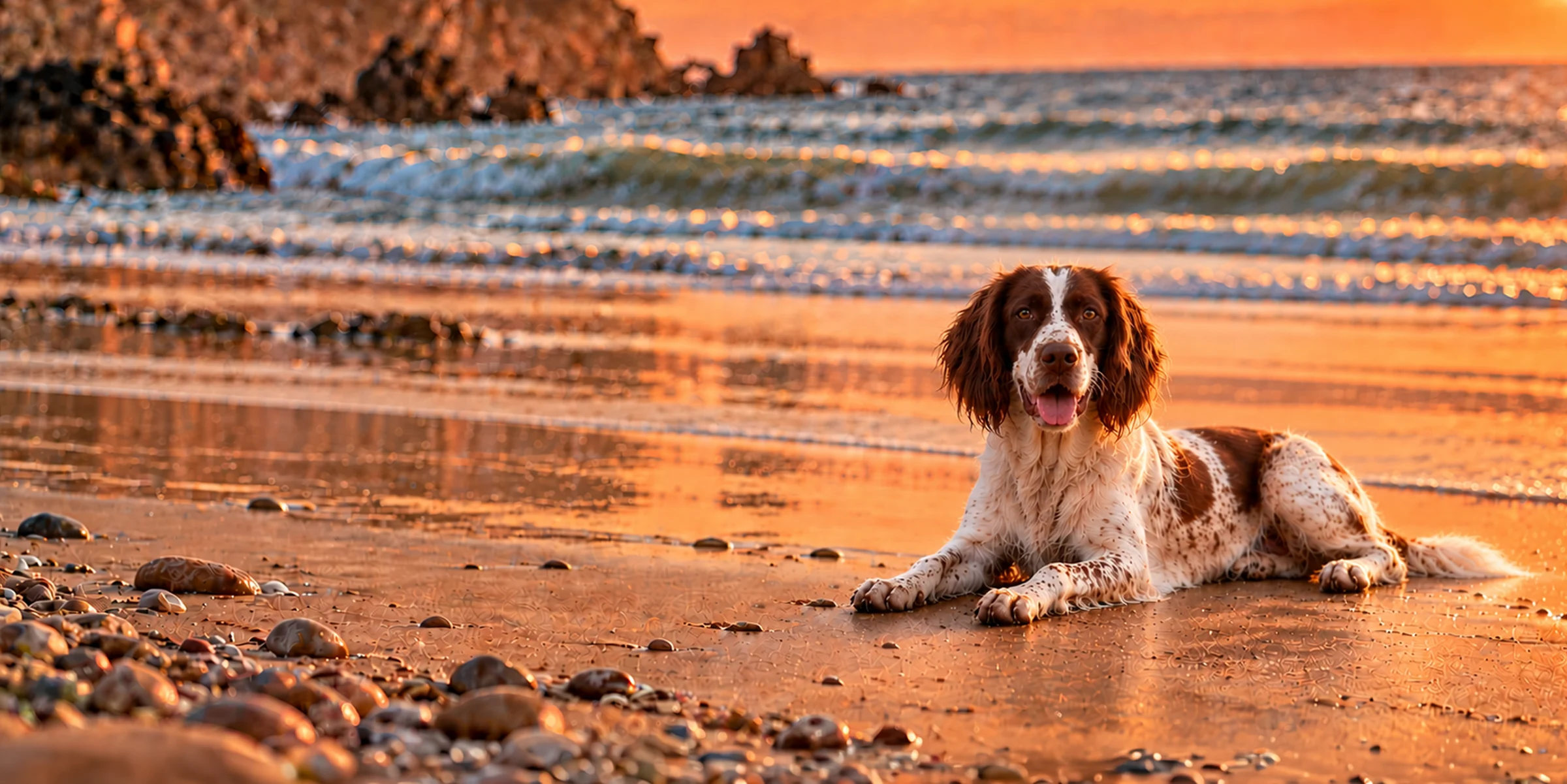
French Spaniel
The brown-and-white cousin from the same French pointing-spaniel stock, and the heavier of the two. French Spaniels were rebuilt from near-extinction by a priest's kennel and are now commonest in Quebec, which is where most North American dogs trace back to.