

small-to-medium breed
Pumi
A Hungarian drover's dog from the hill pastures, bred small and tough enough to push cattle, sheep and pigs down village roads and keep them out of the crops. Twenty-two to twenty-nine pounds, curly-coated, with tipped ears and a permanently amused expression. Pumik need one to two hours of activity a day with real thinking in it, a trim every couple of months, and neighbors who are relaxed about barking.

Pup Height
15-18.5 in

Pup Weight
22-29 lb
Males 16-18.5 in and ideally 27-29 lb, females 15-17.5 in and ideally 22-24 lb. Black, white, any shade of gray, or fawn from pale cream to red; grays are born black and lighten with age, and a small white chest mark or white toe tips are allowed. A curly, corkscrewed coat of harsh hair and softer undercoat standing 1.5-3 in off the body, trimmed rather than corded, with semi-erect ears tipped to the sides and a tail that curls over the back in a full circle. Recognized by the AKC in the Herding Group since 2016. Source: AKC breed standard.

Pup Lifespan
12-13 years
Your pup, at a glance
What’s Life With This Pup Really Like?

Moderate. Affectionate and close with their own family, but more likely to shadow you from room to room than to settle on a lap.

Good with supervision. Playful and loyal with children they know, though a Pumi may herd and nip at running kids and be wary of visiting friends.

Fair. Usually fine with pets raised alongside them, but bossy with other dogs and quick to chase cats and small animals.

Very high. Barking is built into the herding style, and a Pumi comments on everything unless taught an off-switch.

Very high. A working drover built to move all day, who needs both hard exercise and a job for the brain.

Low. The curly coat holds loose hair rather than dropping it around the house.

Bouncy and clownish. Loves ball games, agility and anything new to learn, with a lot of spinning and springing.

Minimal. A clean, dry-mouthed breed.

Very good. Quick and eager with reward-based training, though independent enough to test rules that are not consistent.

Very high. Alert, reserved with strangers and quick to sound the alarm about anything out of place.

Moderate. No daily brushing, but regular combing, air-dried baths and a trim every couple of months.

Moderate. Adjusts to different homes when the exercise and training are there, but the barking makes close neighbors hard.
Lifestyle fit
Could This Be Your Best Breed?
A Pumi is a good match for an active owner who wants a compact partner for agility, herding or long days outdoors, in a house with a fenced yard - $1,600 to $3,000 a year, twelve to thirteen years, and training that never really stops. The barking is the thing to be honest about. For a household that needs quiet, a calmer herding breed is the better choice: a Pumi cannot be trained into silence.

Living Space
A house with a securely fenced yard is the easy fit. The size suits a larger apartment on paper, but a Pumi barks at hallway noises, footsteps and doors, and shared walls turn that into a daily problem with the neighbors.

Pup Experience
Best with someone who has lived with a herding breed or a terrier before, or a first-timer ready to commit to classes. Pumik are clever and quick to learn, and just as quick to find the gaps in a rule that is not enforced every time.

Daily Pup Time
One to two hours of activity a day, with real mental work in the mix - training, a dog sport or herding - plus a comb-through every week or two and a trim every couple of months.

Allergies & Coat
The Pumi scores 3/10 for shedding and 1/10 for drooling. No dog is truly hypoallergenic. The allergens come from dander and saliva, and a coat that sheds this little leaves far less of them on your furniture, floors, and clothes.
Quirks & challenges
The Not-So-Easy Stuff

Alert Barking
Barking is part of the herding style, and a Pumi announces visitors, noises and anything out of place. A taught quiet cue is essential.
Wary of Strangers
Naturally reserved with unfamiliar people. Broad socialization through puppyhood keeps caution from becoming reactivity.
Terrier-Like Streak
Bold, bossy with other dogs and keen to chase small animals. Early manners and supervised introductions matter.
Herding and Nipping
Running children, bikes and joggers can trigger heel-nipping. Give the instinct an outlet and set firm limits.
Needs a Job
A leashed walk is not enough. A Pumi without training, sport or work invents projects, usually noisy ones.
Coat Upkeep
The curls hold burrs and debris and need combing and trimming every couple of months to keep their shape.
The good, the bad & the hairy
Health, Care & Costs
Understanding the health risks and ongoing costs of a Pumi helps you plan for a happy, healthy life together.

12-13 years
$60-$100
per groom (bath, trim, nails, ears) every 8-10 weeks, or much less if you learn to trim at home ($0-$600/year)
$1,600-$3,000/year
all-in (food, routine vet, grooming, insurance, incidentals)

Health Risks
Conditions this breed is prone to.

The hip joint forms loosely and wears into arthritis over time. Hip x-rays are one of the breed club's required CHIC tests, so both parents should have OFA or equivalent scores.
The kneecap slips out of its groove, showing as a skip or hop in the gait. Mild cases need no treatment and severe ones need surgery; a veterinary patella check on both parents is part of the CHIC list.
An inherited eye disease in which the lens slips out of place, causing pain and glaucoma that can lead to blindness quickly if not treated. A DNA test for the ADAMTS17 mutation is required for CHIC, and carriers should never be bred to carriers.
A slow, progressive spinal cord disease that weakens the hind legs in older dogs. A DNA test for the SOD1 mutation identifies clear, carrier and at-risk dogs; it is a CHIC requirement in the breed, and at-risk results do not always mean a dog develops the disease.
PRA and other inherited eye conditions are possible, but no breed-specific PRA DNA test is part of the Pumi health program. An eye examination by a board-certified veterinary ophthalmologist is the screen, so ask whether the parents have had one.
Abnormal development of the elbow that causes front-leg lameness in young, active dogs. Elbow x-rays are an optional CHIC test for the breed; ask for results and avoid hard jumping until growth is finished.

Insurance & Health Coverage
Insure young. Hip dysplasia, elbow trouble and luxating kneecaps usually show in the first few years, and once a symptom is on the record it becomes a pre-existing exclusion for good.

Active dogs get hurt. A Pumi doing agility or herding, or simply spinning and sprinting around the yard, is at real risk of torn ligaments, strains and cuts, so accident cover counts as much as illness cover.

The DNA-testable conditions - primary lens luxation and degenerative myelopathy - are inherited, and a policy will not protect you from bad genetics. Tested parents are the protection; ask the breeder for both sets of results before you commit.
 Get a Pet Insurance Quote
Care needs
The Daily Routine

Grooming
A curly coat that sheds little and does not need daily brushing - in fact, frequent brushing ruins the curls. Comb through every week or two to catch tangles and burrs, bathe as needed and let the coat air-dry so the corkscrews re-form, and trim every couple of months to keep the outline and the tipped ears neat. Never blow the coat straight or shave it.

Exercise
One to two hours a day of real activity - running, hiking, ball games and, above all, work for the brain such as training, agility, scent games or herding. A Pumi who gets only a leashed walk turns the leftover energy into barking and chasing.

Food & Weight
A quality food for an active, medium-sized dog, measured rather than free-fed. Sport and working Pumik may need more calories in busy seasons; companions need less. Keeping them lean protects the hips, elbows and knees.
Similar breeds
If This Isn’t Quite the One

Mudi
The closest relative - another compact Hungarian farm herder with the same busy, vocal, watchful temperament. The Mudi has a wavy, lower-maintenance coat and upright ears; the Pumi has the corkscrew curls, the tipped ears and more trimming to do.
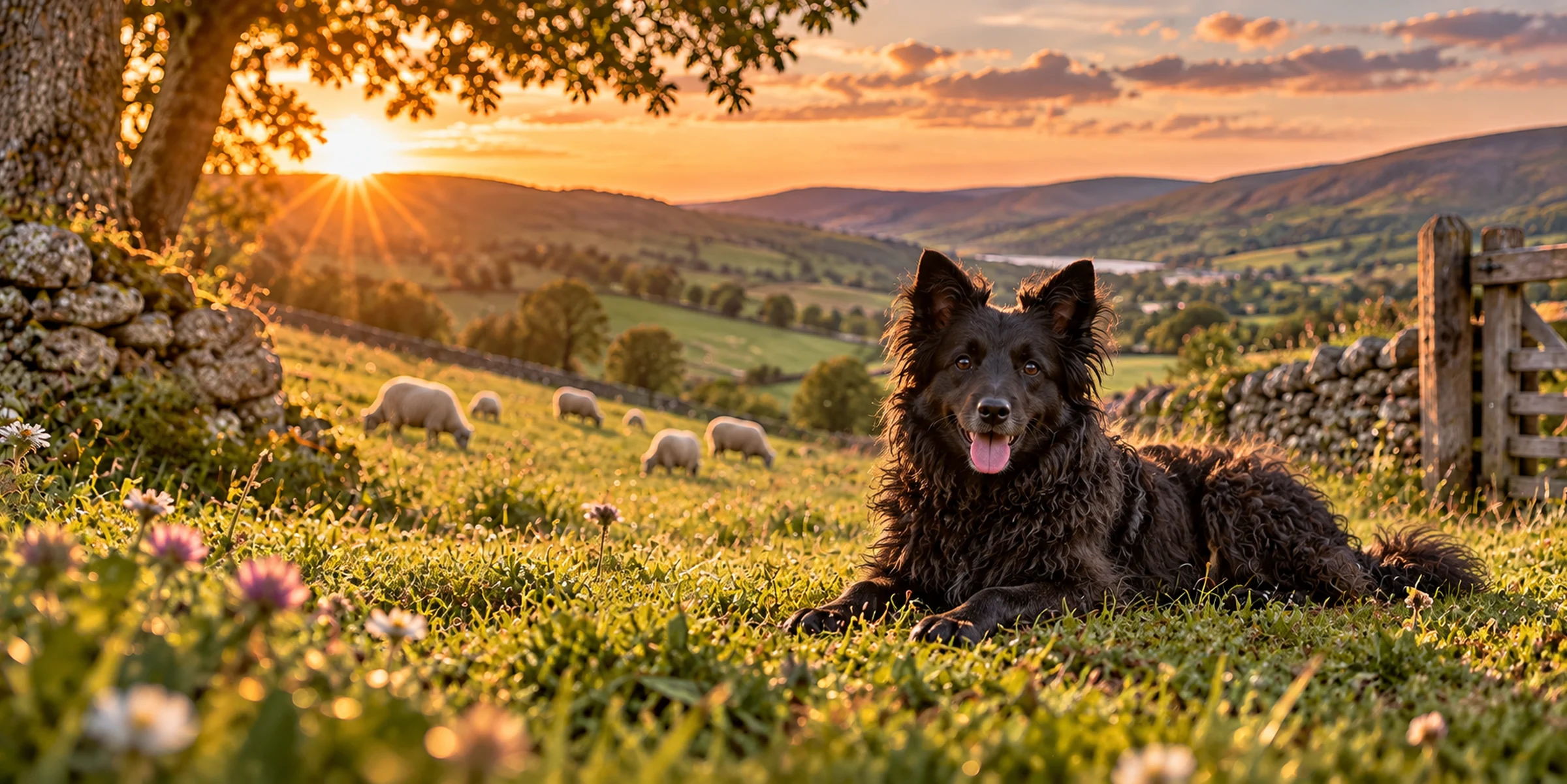
Croatian Sheepdog
A similar Central European farm herder with a curly-to-wavy coat and a lot to say. The Croatian Sheepdog is always black, a little larger and more of a one-person dog; the Pumi comes in more colors and is more playful with the whole family.

Border Terrier
For someone drawn to the terrier side of the Pumi - bold, game and keen on chasing. The Border Terrier is smaller, quieter at home and friendlier with strangers; the Pumi is a real herder with far more energy and a much bigger bark.

Miniature American Shepherd
A similar size and the same sport-dog drive. The Miniature American Shepherd is easier to find, more outgoing with strangers and sheds a lot more; the Pumi is warier, noisier and sheds far less.