

medium breed
Thai Bangkaew
Thailand's village guardian, traced to a single black-and-white female kept by a Buddhist abbot at Wat Bangkaew and bred to a settled type from 1957. Thai Bangkaew are devoted to their own household, quick to learn, fond of water and genuinely territorial. The work is in what comes with that: suspicion of every visitor, conflict with same-sex dogs that rarely stops once it starts, and a dense double coat shedding all year on a tropical dog.

Pup Height
16-21 in

Pup Weight
35-43 lb
Males 18-21 in and 40-43 lb, females 16-19 in and 35-40 lb, square-built and never low on the leg. A double coat - straight, coarse guard hair over a soft, dense undercoat - moderately long on the body and longer around the neck and shoulders, where it forms a ruff that is heavier on males, with feathering behind the forelegs and a plumed tail. White with well-defined patches in any shade of lemon, red, fawn, tan or gray, with or without blackened tips, and also white with solid black patches; an all-white coat is a severe fault. In the AKC's Foundation Stock Service since 2023. Source: AKC Foundation Stock Service breed standard.

Pup Lifespan
14-17 years
Your pup, at a glance
What’s Life With This Pup Really Like?

High, and reserved for their own people. Thai Bangkaew are affectionate and physically close at home and show a visitor none of it.

Good with the children of their own household when raised alongside them. Visiting children are a different matter, and the wariness toward strangers does not distinguish by age.

Limited. Same-sex conflict with other dogs is commonly reported, and cats and small pets depend on being raised together from the start.

High. A watchdog's bark, aimed at anything crossing the boundary, and one of the first things neighbors will mention.

Moderately high. An hour to ninety minutes daily with mental work, then genuinely settled indoors.

Heavy. A dense double coat that sheds all year and drops the undercoat twice a year in sheets.

Playful well into adulthood with their own family, and often delighted by water. Games with strangers are not on offer.

Minimal. A dry-mouthed, fastidious breed that stays clean with very little help.

Good. Bright, attentive and described in the standard as easy to train, with the caveat that repetition loses them quickly.

Very strong. Territorial, alert and protective by instinct - the reason the breed exists, and the trait that most needs managing.

Moderate. A weekly brush most of the year, daily work through the blowouts, and no trimming or shaving at any point.

Low. The guarding instinct, the barking and a heavy coat in a hot climate all limit where Thai Bangkaew can reasonably live.
Lifestyle fit
Could This Be Your Best Breed?
A Thai Bangkaew needs solid fencing and a yard with visible edges, plus an owner who has handled a protective breed and will run socialization on a schedule for two years. The breed is cheap at $1,200 to $2,100 a year and long-lived at fourteen to seventeen. An open front door, a steady stream of visitors, or another dog of the same sex already in the house is reason enough to choose something else.

Living Space
A house with solid fencing and a yard they can see the edges of. Thai Bangkaew patrol what they consider theirs and announce anything that crosses the line, which makes shared walls and communal entrances hard work. Shade and a cool floor matter more than acreage.

Pup Experience
Not a first dog. The training itself is straightforward - Thai Bangkaew are bright and want to work with their own person - but the guarding instinct, the wariness toward strangers and the friction with same-sex dogs all want an owner who has handled a protective breed before and will do socialization on a schedule rather than when it is convenient.

Daily Pup Time
An hour to ninety minutes of exercise and training daily, plus deliberate socialization outings through the first two years. Grooming is a weekly brush that turns daily for a few weeks twice a year.

Allergies & Coat
The Thai Bangkaew scores 8/10 for shedding and 1/10 for drooling. No dog is truly hypoallergenic. The allergens come from dander and saliva, and a dog that sheds this much will leave plenty of hair behind - especially on your furniture, floors, and clothes.
Quirks & challenges
The Not-So-Easy Stuff

Guarding Is the Default
Thai Bangkaew watch their own ground and mean it. The instinct needs managing and directing, not training out.
Suspicious of Visitors
Unfamiliar people are met with reserve at best. Wide, early socialization decides whether that reserve stays polite.
A Double Coat in the Heat
A dense undercoat on a tropical breed. Shedding is heavy year-round and hard exercise belongs at dawn and dusk.
Same-Sex Dog Conflict
Commonly reported, and Bangkaew do not back down once a fight starts. Many do best as the only dog of their sex.
Rare Outside Thailand
Few American litters and a Foundation Stock Service listing rather than full recognition. Expect a wait and a long drive.
Switches Off in Training
Quick to learn and quick to disengage. Short, varied sessions work; drilling the same exercise loses them.
The good, the bad & the hairy
Health, Care & Costs
Understanding the health risks and ongoing costs of a Thai Bangkaew helps you plan for a happy, healthy life together.

14-17 years
$50-$80
per groom (bath, blow-out, de-shed, nails, ears), every 8-12 weeks or done at home ($0-$400/year)
$1,200-$2,100/year
all-in (food, routine vet, grooming, insurance, incidentals)

Health Risks
Conditions this breed is prone to.

Worth stating first. Health testing is not yet standard practice in the country of origin, so breed-level statistics barely exist. What the parent club reports is a healthy, long-lived breed with no particular cancer burden - encouraging, but thin evidence rather than a clean bill of health.
The parent club names early eye conditions as the breed's biggest current concern. PRA destroys the retina gradually and ends in blindness, with no treatment once it starts. No breed-specific DNA test is established yet, so annual CAER eye examinations on both parents are the screening that actually exists.
The hip joint develops loosely so the ball wears in the socket instead of gliding, leading to arthritis. Only a few cases have been noted so far, and the club recommends hip scoring on breeding stock as standard for a medium breed rather than waiting for a pattern to appear.
A thick undercoat over warm, humid skin is where hot spots, yeast and ear infections start, and a coat that is never brushed to the skin makes all three more likely. Weekly brushing and a weekly look inside the ears is most of the prevention.
Relevant to a breed whose stock still comes from Thailand. Ehrlichiosis and babesiosis are carried by the brown dog tick and are common across Southeast Asia, and an imported dog is worth blood-screening on arrival. Year-round tick prevention is sensible either way.
Worth listing on its own. The American population descends from a handful of imports, so the individual breeder's pedigree knowledge and willingness to test counts for far more than breed-level statistics do.

Insurance & Health Coverage
A long-lived breed with no heavy inherited-disease burden on record, so premiums should be reasonable. Read that carefully, though - part of the reason nothing is on record is that nobody has been recording, and cover is always broadest before anything has been written on the file.

Eyes are where the small print matters. Early-onset conditions are the club's stated concern, and anything congenital, or already noted at an examination, sits outside every policy. The parents' eye certificates are more protection than any policy provides, so ask for them before you commit to a puppy.

Then plan for length. Fourteen to seventeen years is a long tail of senior care, and cover that is dropped or repriced at ten leaves exactly the years that cost the most. Check the lifetime renewal terms rather than the first-year premium. A word with your home insurer is worth it too: some list guarding breeds, and third-party liability on a territorial dog is a thing to confirm rather than assume.
 Get a Pet Insurance Quote
Care needs
The Daily Routine

Grooming
A thorough brush once or twice a week for most of the year, and daily work with an undercoat rake through the twice-yearly blowouts - the ruff behind the ears and the feathering on the legs mat first. The coat is largely self-cleaning and wants no trimming at all, so baths are occasional. Never shave a Thai Bangkaew: the undercoat is what holds heat off the skin, and taking it away in summer makes overheating worse rather than better.

Exercise
An hour to ninety minutes daily with something in it for the mind. Long walks, hiking, scent work and swimming all suit them - the breed has a genuine liking for water - and short training sessions do more than extra distance does. In warm weather the hard work belongs at dawn and dusk.

Food & Weight
Two measured meals for a compact dog of 35 to 43 pounds who puts weight on quietly once the daily exercise slips. The double coat hides condition, so go by feel through the ribs rather than by eye, and keep training treats inside the day's total.
Similar breeds
If This Isn’t Quite the One
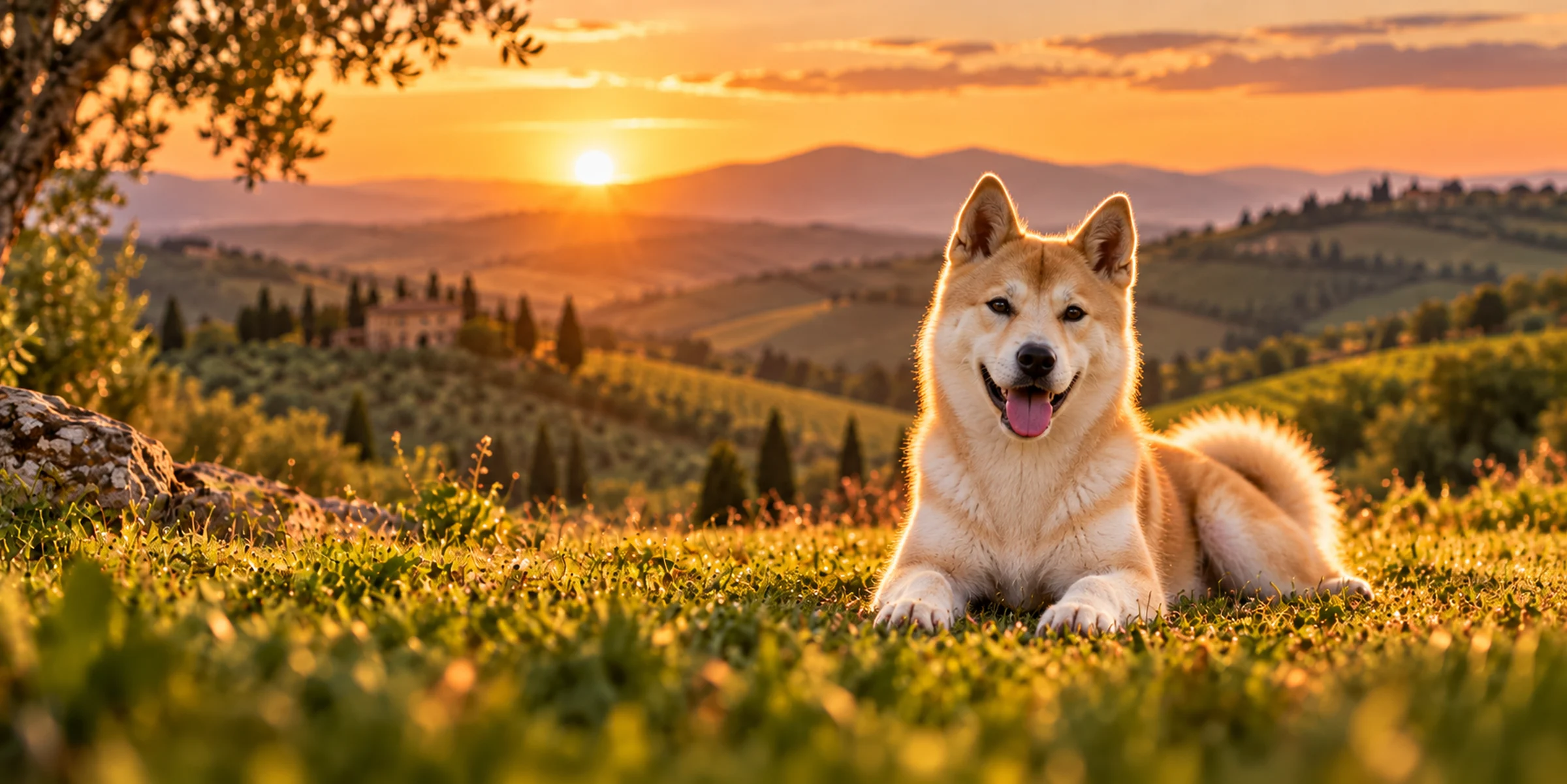
Korean Jindo Dog
The closest match on this site - a medium East Asian spitz of almost the same size, similarly serious as a watchdog and similarly hard to find. The Jindo is a hunter with heavy prey drive who bonds to one person; the Bangkaew is a village guardian, more territorial than prey-driven and attached to the whole household.

Japanese Spitz
The white spitz people often land on first, and a very different dog. Japanese Spitz weigh half as much, are white all over rather than white with colored patches, and were bred purely as companions - sociable with strangers, with none of the Bangkaew's guarding edge.

Shiba Inu
Another compact Asian spitz with a double coat and a strong sense of self, and far easier to find in the United States. The Shiba is smaller, a hunter rather than a guardian, and famously unreliable off leash; the Bangkaew is bigger, more territorial and more trainable.