

small-to-large cross
Sheepadoodle
Not a breed but a cross - Old English Sheepdog to Poodle, with no kennel club standard behind it, so size, coat and temperament all ride on the two parents. Most land big, goofy and unusually good-natured with children, with herding manners from one side and a fast brain from the other. The coat is the whole decision: two of the heaviest-matting coats in dogs, combined on a 50-to-80-pound frame.

Pup Height
16-27 in

Pup Weight
25-80 lb
No kennel club recognizes the Sheepadoodle, so there is no breed standard and no reliable average. Size follows the generation and which Poodle was used - a cross to a Standard Poodle usually lands between 50 and 80 lb, while mini Sheepadoodles out of a Miniature Poodle run roughly 25-45 lb. At the shoulder, minis stand about 16-22 in and standards about 22-27 in. Color is most often black and white or gray and white in some patched or merle-ish pattern, and coat texture runs from flat through wavy to tight wool within a single litter. The parents' actual weights are the only useful guide.

Pup Lifespan
11-13 years
Your pup, at a glance
What’s Life With This Pup Really Like?

Very high. Both parents are people-focused, and a Sheepadoodle usually wants to be leaning on someone rather than in the next room.

Excellent, and the reason most families choose one. Two caveats: a bouncy 60-pound adolescent can flatten a toddler, and the herding instinct may show up as bumping children who run.

Good. Little guarding instinct on either side, and most settle with cats raised alongside them - though the herding half may try to organize them.

Moderate. The Sheepdog side brings a loud, deep announcement bark; the rest is boredom-driven and answers to exercise rather than correction.

Moderate to high, around an hour a day plus mental work. More of a homebody than the sporting doodles, less driven than a Labradoodle, and still far too much dog for a walk around the block.

Low in most, but never guaranteed. It turns on whether a puppy inherits the furnishings variant, and a flat-coated littermate sheds like an Old English Sheepdog. Low shedding is also not hypoallergenic.

Very playful and clownish. Puppyish for years, happy with fetch, water, puzzles and anything that involves the family.

Low as drool goes, though the beard comes out of the water bowl soaked and redistributes it across the floor.

High. Quick, food-motivated and willing, with an independent streak from the droving side - short varied sessions work, drilling does not.

Low to moderate. Loud enough to announce a visitor, far too friendly to be anything more than a doorbell.

As high as it gets, and the single reason these dogs get rehomed. Both parents have coats that mat to the skin, and combining them on a 50-to-80-pound dog - a Standard Poodle over an Old English Sheepdog, which is what the size rating assumes - means line brushing several times a week and a professional groom every six to eight weeks for life. Coat texture varies litter to litter, so the puppy you meet is not a promise about the one you get.

Moderate. Flexible about routine, much less so about small homes, hot climates and long days alone.
Lifestyle fit
Could This Be Your Best Breed?
A Sheepadoodle suits a family with room, an hour a day and a standing grooming budget - $2,400 to $4,000 a year, $700 to $1,400 of that at the groomer alone. The temperament rarely causes the trouble; the coat does, because it mats to the skin between appointments unless someone brushes right down through it. If a groom every six to eight weeks is not money you can commit to for twelve years, stop here.

Living Space
A house with a fenced yard suits them best. Standard crosses are large, bouncy and slow to settle indoors, and the coat carries mud and water in on every trip; an apartment works only for a clipped, thoroughly exercised adult.

Pup Experience
The temperament is first-timer friendly and the coat is not. Training a cheerful, clever dog is the easy half - keeping a big doodle coat out of mats for twelve years is the half people underestimate.

Daily Pup Time
About an hour of exercise plus something to think about, and 10-20 minutes of coat work most days. Add a half day at the groomer every six to eight weeks, for life.

Allergies & Coat
The Sheepadoodle scores 3/10 for shedding and 3/10 for drooling. No dog is truly hypoallergenic. The allergens come from dander and saliva, and a coat like this one holds on to them rather than spreading them around your home - which is what a groomer is clearing out every six to eight weeks.
Quirks & challenges
The Not-So-Easy Stuff

Coat Mats To The Skin
Two matting coats on one big dog. Brush the surface only and the mats form underneath, and the groomer shaves rather than saves them.
Herding The Kids
Bumping, circling and nudging children who run. Redirect it early rather than letting it turn into a game.
Grooming Wriggles
A stranger with clippers handles this dog every six weeks for life. A puppy who was never taught to stand for it becomes an adult who has to be sedated.
Boisterous Adolescence
Large, strong and slow to grow up. Jumping and leash-pulling are much easier to fix at 30 lb than at 70.
Home Alone Blues
Both parent breeds bond hard, and a Sheepadoodle left all day gets vocal and destructive.
Wet Beard, Muddy Feet
The beard comes out of the water bowl soaked and drips across the floor, and the leg hair brings the yard indoors.
The good, the bad & the hairy
Health, Care & Costs
Understanding the health risks and ongoing costs of a Sheepadoodle helps you plan for a happy, healthy life together.

11-13 years
no breed-specific study exists; this spans the two parent breeds' figures
$90-$150
per professional groom, every 6-8 weeks ($700-$1,400/year - large dogs are charged as such)
$2,400-$4,000/year
all-in (food, routine vet, grooming, insurance, incidentals)

Health Risks
Conditions this breed is prone to.

Both the Old English Sheepdog and the Standard Poodle carry it, so a cross does nothing to dilute the risk. The joint develops loosely and grinds rather than glides, ending in arthritis and sometimes replacement surgery. Ask for OFA or PennHIP results on both parents, and keep a big puppy lean and slow-growing.
Both parents are deep-chested, which makes this a genuinely shared risk rather than a one-sided one. The stomach fills with gas and twists, cutting off its own blood supply, and without surgery within hours it is fatal. Feed two measured meals rather than one large one, keep hard exercise clear of mealtimes, and learn the signs of unproductive retching and a swollen belly now rather than at 2am.
An inherited defect in the tiny hairs that clear mucus from the airways, causing repeated pneumonia and nasal discharge from puppyhood. It comes from the Old English Sheepdog side, it is recessive, and a DNA test exists for the mutation seen in that breed - so a tested Sheepdog parent takes it off the table.
A mutation in the MDR1 (ABCB1) gene lets certain drugs, including high-dose ivermectin and loperamide, build up in the brain and cause serious neurological reactions. It exists in the Old English Sheepdog, much less often than in Collies but often enough to matter, and a cheek-swab DNA test settles it. Get the dog tested even where the parents were not, and make sure the result is on the vet record.
Three separate Old English Sheepdog problems worth asking about together. Hereditary deafness in one or both ears is found by a BAER test on puppies from about six weeks. Hereditary cerebellar ataxia, a late-onset loss of coordination, has a DNA test. Autoimmune hemolytic anemia, where the immune system destroys red blood cells, has no test at all - pale gums, weakness or collapse are an emergency.
The Poodle side's three. Progressive retinal atrophy slowly destroys the retina and ends in blindness; the prcd form has a DNA test, and both parents should have one. Sebaceous adenitis destroys the skin's oil glands, leaving dry scaly skin and patchy coat loss, managed with oil baths rather than cured. Addison's disease is vague enough - lethargy, vomiting, poor appetite - that it is usually missed until a crisis, then medicated for life.

Insurance & Health Coverage
Insure early, and read the annual limit rather than the premium.

This is a large cross with orthopedic risk from both parents, and hip surgery commonly runs $4,000-$7,000 per side. Bloat surgery is several thousand more, on a few hours' notice.

The Poodle and Sheepdog lines also contribute conditions that are managed for life rather than fixed - Addison's, sebaceous adenitis, autoimmune hemolytic anemia - and those are recurring annual claims that hit a low cap fast.
What insurance cannot do is cover the predictable cost. Grooming is a four-figure line item every year for as long as the dog lives, and no policy touches it.
The DNA-testable conditions are the part you control: PCD, MDR1, cerebellar ataxia and prcd-PRA all have tests, and asking for the parents' results is worth more than any policy.
 Get a Pet Insurance Quote
Care needs
The Daily Routine

Grooming
Line brushing right down to the skin several times a week with a pin brush, slicker and steel comb - the surface can look fine while the coat is felted underneath. Professional groom every 6-8 weeks without exception, and expect a groomer to shave a neglected coat rather than spend hours dematting a dog who is uncomfortable. Dry the coat thoroughly after every bath or soaking, wipe the beard after meals, and keep the hair around the eyes, feet and rear trimmed.

Exercise
About an hour a day of walks and play, plus real mental work - scent games, training, agility or rally. Less driven than a Labradoodle and more of a homebody, but under-exercised Sheepadoodles turn a big body loose on the house. Go easy on hard running and jumping until the joints finish growing at around 12-18 months, and exercise at the cool ends of the day in summer.

Food & Weight
No standard exists behind this cross, so adult weight ranges widely and the chart on the bag is a poor guide - feed the dog in front of you, with ribs easy to feel and a waist visible from above. The coat hides weight gain completely, so judge by feel rather than eye. Two measured meals a day, large-breed puppy food while growing, and nothing strenuous around mealtimes given the bloat risk.
Similar breeds
If This Isn’t Quite the One

Old English Sheepdog
One parent, and the record with the real data - a written standard, a measured lifespan and a century of evidence. The Sheepdog sheds where the cross often does not, but the coat demands are just as heavy and far more predictable.

Standard Poodle
The other parent, and the predictable version of the coat. A Standard Poodle gives you a known size, a known temperament and a coat that behaves the same way in every litter, rather than a lottery.
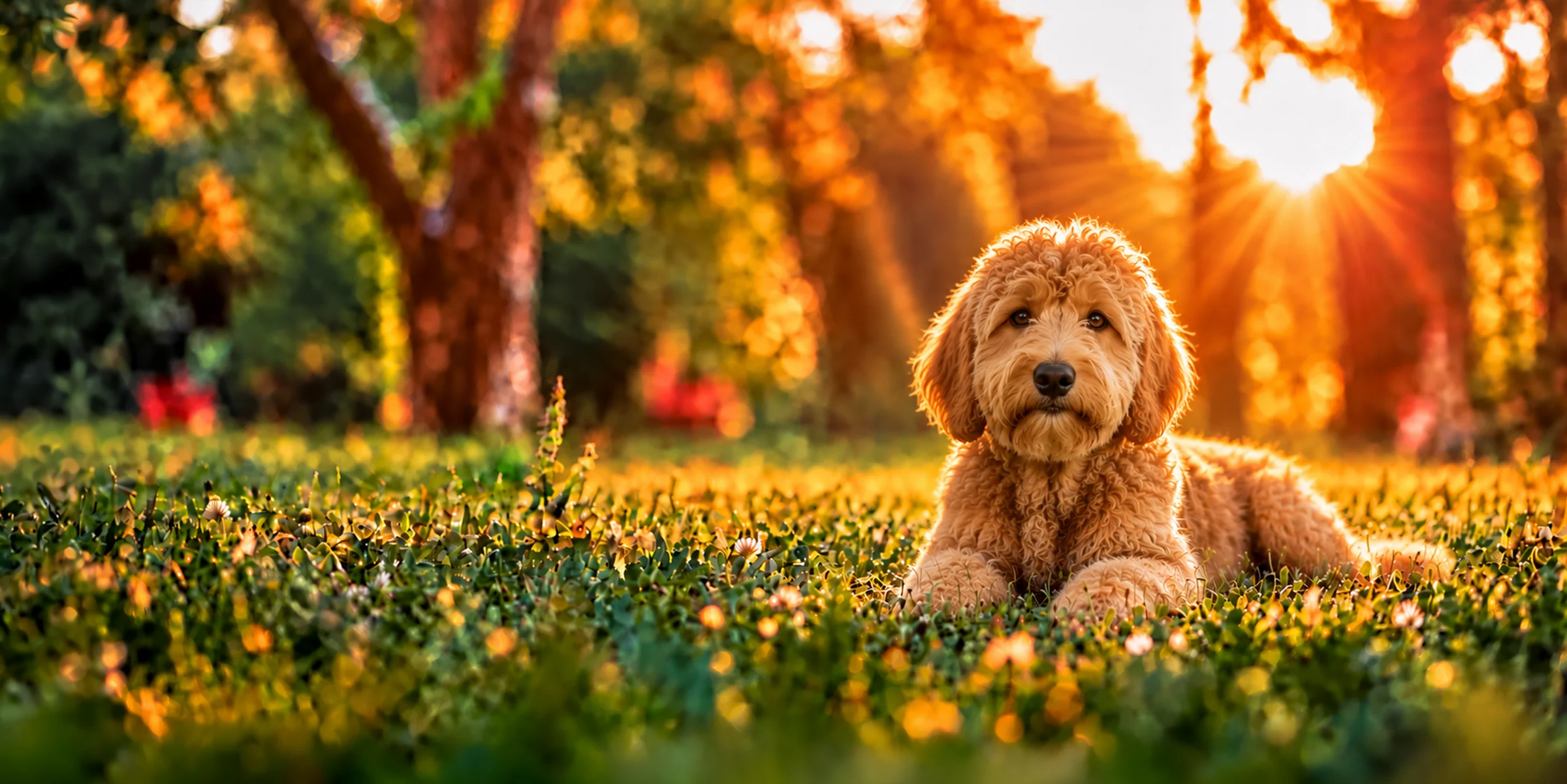
Goldendoodle
The same grooming bill in a softer, more biddable package, with no herding streak and less bulk to manage through adolescence.